Understanding Skin: What Supports Healthy Skin?
We often think about skin in terms of what we can see: its texture, tone, clarity, softness or the changes that become visible over time.
But skin is much more than what we see.
It is a complex, living organ that forms the interface between our body and the world around us. It provides a protective barrier, helps regulate temperature and water loss, contributes to immune defence and allows us to experience sensations such as touch, pressure and temperature (Yousef et al., 2024).
Understanding a little more about how our skin functions can change the way we think about caring for it. Rather than focusing only on appearance, we can begin to think about skin health in terms of supporting the structures and functions that allow our skin to do its job.
Understanding Our Skin
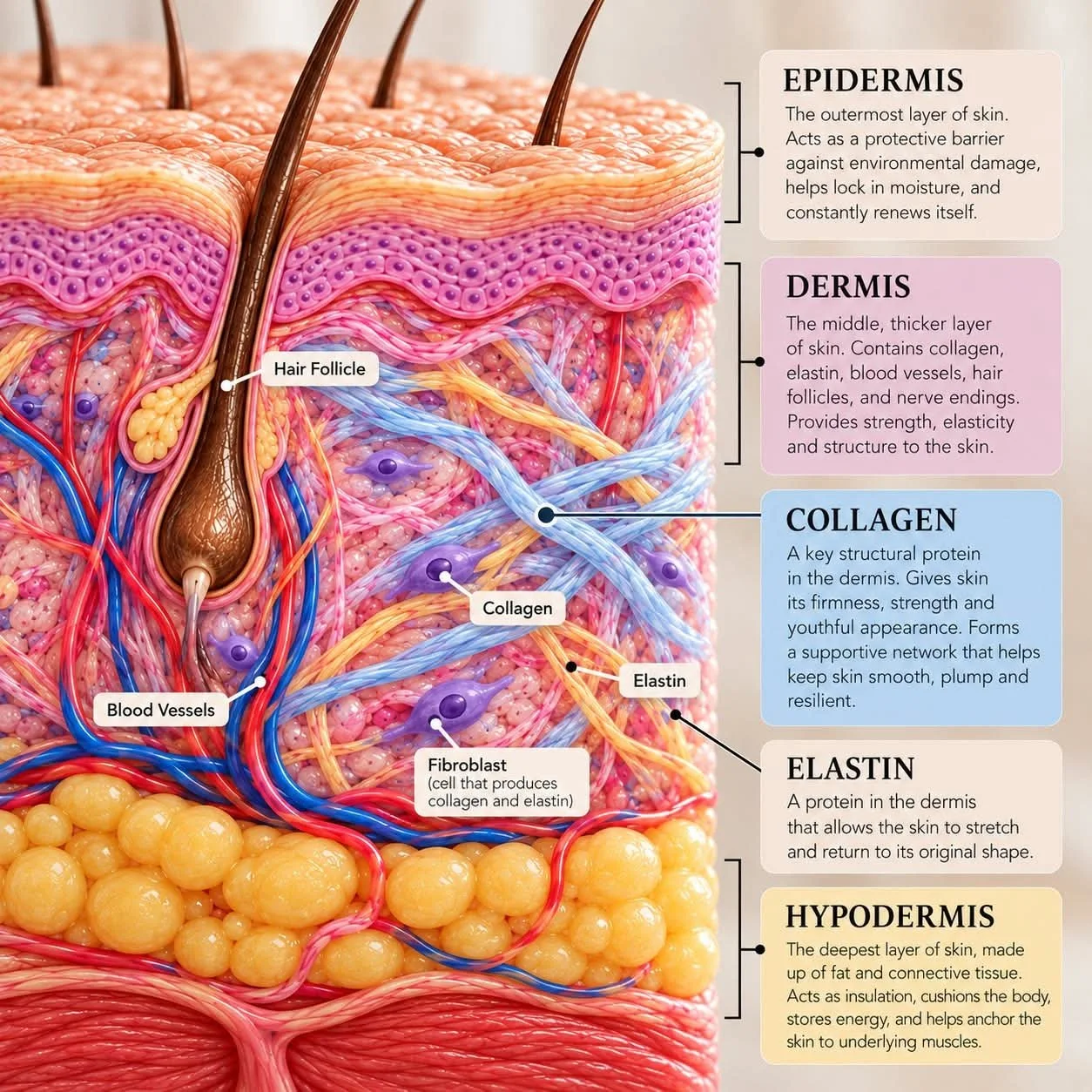
Skin consists of three principal layers: the epidermis, dermis and hypodermis, each with its own structure and function (Agarwal & Krishnamurthy, 2023; Yousef et al., 2024).
The epidermis is the outermost layer of our skin. Its predominant cells are keratinocytes, which are continually produced in the deeper regions of the epidermis before moving towards the skin's surface. At the outermost part sits the stratum corneum, specialised cells surrounded by an organised lipid matrix that forms an important part of what we commonly refer to as the skin barrier (Bouwstra & Gooris, 2023). A well-functioning skin barrier helps limit excessive water loss while protecting against the external environment.
The dermis sits beneath the epidermis, a deeper layer of connective tissue containing blood vessels, nerves, hair follicles and glands, along with an extracellular matrix that provides much of the skin's structural framework. This matrix includes collagen, elastin and hyaluronic acid: collagen contributes tensile strength, elastin allows the skin to stretch and recoil, and hyaluronic acid supports hydration (Shin et al., 2019). Fibroblasts are the cells responsible for producing and maintaining much of this matrix.
Below the dermis lies the hypodermis, or subcutaneous tissue, composed largely of adipose and connective tissue, contributing to cushioning, insulation and structural support (Yousef et al., 2024).
So, what does “Healthy Skin” actually mean?
Healthy skin does not necessarily mean flawless skin. Pores, texture, pigmentation, fine lines and changes over time are all normal characteristics of human skin.
From a physiological perspective, skin health is better considered in terms of how effectively the skin performs its functions, maintaining an effective barrier, regulating water loss, providing protection and continually renewing itself.
Hydration forms part of this picture, but it's more complex than simply drinking water or applying a hydrating product. The organisation of the stratum corneum and its lipids plays an important role in regulating how water moves through the skin and evaporates from its surface (Bouwstra & Gooris, 2023), which is one reason why supporting the skin barrier matters so much.
Our skin is always changing
Our skin does not remain static. Its structure, function and appearance are shaped by a combination of intrinsic factors, genetics and the natural changes of ageing and extrinsic factors, including UV exposure, environment and lifestyle.
Hormonal changes influence the skin too. Oestrogen has physiological roles within the skin, and the changes in circulating oestrogen associated with menopause have been linked with changes in dermal collagen, elasticity and hydration.
Rather than viewing every change as a problem to be corrected, we can recognise that our skin is a dynamic organ responding to our biology, environment and different stages of life.
Collagen and Our Skin
Collagen is one of the major structural proteins of the human body and an important component of the dermal extracellular matrix, contributing to the skin's strength and mechanical properties.
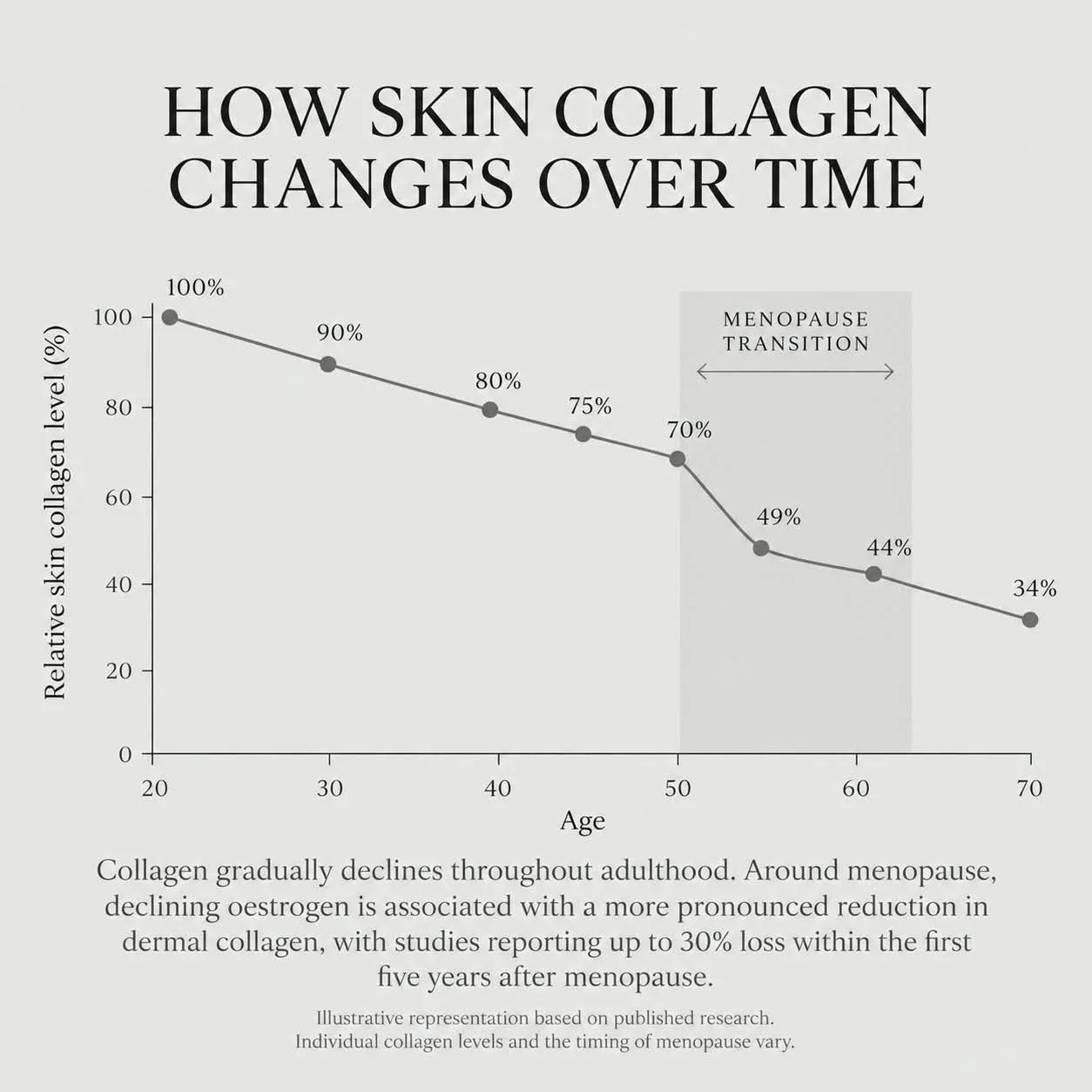
Collagen production begins to decline in early adulthood, and research commonly estimates that skin collagen content decreases by approximately 1% per year during adult life (Shin et al., 2019; Varani et al., 2006). This is a gradual biological process, not an abrupt change at one exact age.
Chronological age is only one part of the story, though. For women, hormonal shifts add another dimension. As much as 30% of skin collagen can be lost in the first five years after menopause, with total collagen content then declining by an average of around 2% per postmenopausal year over the following 15 years (Calleja-Agius et al., 2007). Chronic ultraviolet exposure can also accelerate collagen degradation, contributing to photoageing (Shin et al., 2019), which is why sun protection remains one of the most evidence-backed ways to support the skin's structural framework over time.
What about Collagen Supplements?
Hydrolysed collagen contains collagen proteins broken down into smaller peptides, which can enter the circulation following digestion. A number of studies have investigated oral collagen supplementation in relation to skin hydration and elasticity, with several meta-analyses reporting positive results (Pu et al., 2023).
As with most nutrition research, findings vary depending on the formulation, dosage and study design involved. For this reason, collagen supplementation is best viewed within the broader context of nutrition and skin health as one part of the picture, rather than something that can independently transform the skin.
Skin Health is Bigger Than Skincare
No single product determines the health of our skin. What we see on the outside is influenced by a complex combination of genetics, hormones, environment, nutrition, lifestyle and the products we choose to apply.
Some of the most established ways we can care for our skin are also some of the simplest: protecting it from excessive ultraviolet exposure, avoiding smoking, eating a varied and nutritionally adequate diet, and using skincare that respects the skin barrier.
Nutrition matters because normal skin physiology relies on an adequate supply of energy, protein, essential fatty acids, vitamins and minerals. Vitamin C, for example, is required as a cofactor during normal collagen synthesis, while other micronutrients support antioxidant defence (Pullar et al., 2017).
This doesn't mean more is necessarily better, or that one nutrient can determine how our skin looks or functions. It reinforces the importance of considering skin within the context of overall health. Sleep, stress and everyday habits form part of that picture too.
Begin where you are.
Sources:
-
Agarwal, S., & Krishnamurthy, K. (2023). Histology, skin. In StatPearls. StatPearls Publishing. https://www.ncbi.nlm.nih.gov/sites/books/NBK537325/
Bouwstra, J. A., & Gooris, G. S. (2023). The skin barrier: An extraordinary interface with an exceptional lipid organization. Progress in Lipid Research, 92, 101252. https://doi.org/10.1016/j.plipres.2023.101252
Calleja-Agius, J., Muscat-Baron, Y., & Brincat, M. P. (2007). https://doi.org/10.1258/175404507780796325
Pu, S.-Y., Huang, Y.-L., Pu, C.-M., Kang, Y.-N., Hoang, K. D., Chen, K.-H., & Chen, C. (2023). Effects of oral collagen for skin anti-aging: A systematic review and meta-analysis. Nutrients, 15(9), 2080. https://doi.org/10.3390/nu15092080
Pullar, J. M., Carr, A. C., & Vissers, M. C. M. (2017). The roles of vitamin C in skin health. Nutrients, 9(8), 866. https://doi.org/10.3390/nu9080866
Shin, J.-W., Kwon, S.-H., Choi, J.-Y., Na, J.-I., Huh, C.-H., Choi, H.-R., & Park, K.-C. (2019). Molecular mechanisms of dermal aging and antiaging approaches. International Journal of Molecular Sciences, 20(9), 2126. https://doi.org/10.3390/ijms20092126
Varani, J., Dame, M. K., Rittie, L., Fligiel, S. E. G., Kang, S., Fisher, G. J., & Voorhees, J. J. (2006). Decreased collagen production in chronologically aged skin: Roles of age-dependent alteration in fibroblast function and defective mechanical stimulation. The American Journal of Pathology, 168(6), 1861–1868. https://doi.org/10.2353/ajpath.2006.051302
Yousef, H., Alhajj, M., Fakoya, A. O., & Sharma, S. (2024). Anatomy, skin (integument), epidermis. In StatPearls. StatPearls Publishing. https://www.ncbi.nlm.nih.gov/sites/books/NBK470464/